Born Into the Rhythm. Raised Inside the Tradition.
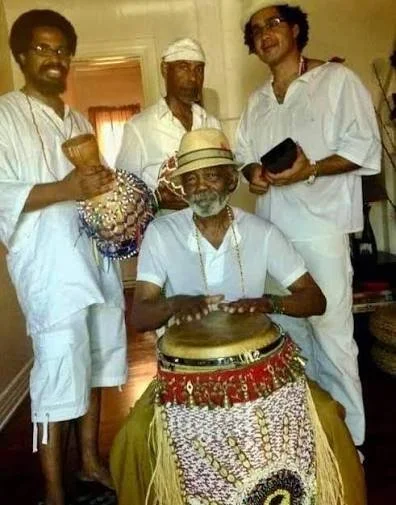
Atoyebi Garcia Villamil is a cultural bearer, educator, and performer rooted in one of the most extraordinary lineages in Afro-Cuban sacred tradition. He is the son of Felipe García Villamil — a master drummer, ritual craftsman, and 2000 NEA National Heritage Fellow born in Matanzas, Cuba — whose life and artistry were chronicled in the Temple University Press biography Drumming for the Gods by ethnomusicologist María Teresa Vélez.
Raised within the living traditions of Lucumí (Santería), Palo Monte, and Abakuá, Atoyebi performed alongside his father and brothers Ajamu and Miguel as part of the Villamil family ensemble — a drumming dynasty documented by the Smithsonian Institution and the National Endowment for the Arts.
Today, Atoyebi carries this inheritance forward as a workshop facilitator, cultural consultant, and performing artist. His mission is to preserve, educate, and share the Afro-Cuban sacred traditions passed to him through blood and decades of lived practice — traditions traceable directly to the Yoruba city-state of Oyo in present-day Nigeria and the sacred Cabildo de San Juan Bautista in Matanzas, Cuba.
A Legacy Documented by the Nation
My father's life is preserved in Drumming for the Gods — a Temple University Press biography by ethnomusicologist María Teresa Vélez. His altar work was dedicated to by Yale professor Robert Farris Thompson. His drumming was recorded and archived by the National Endowment for the Arts and the Smithsonian Institution.
I am the next chapter of that record.
I carry these traditions not as a museum piece — but as a living practice. My father taught me that the drum speaks what words cannot. My work is to make sure that voice is never silenced.